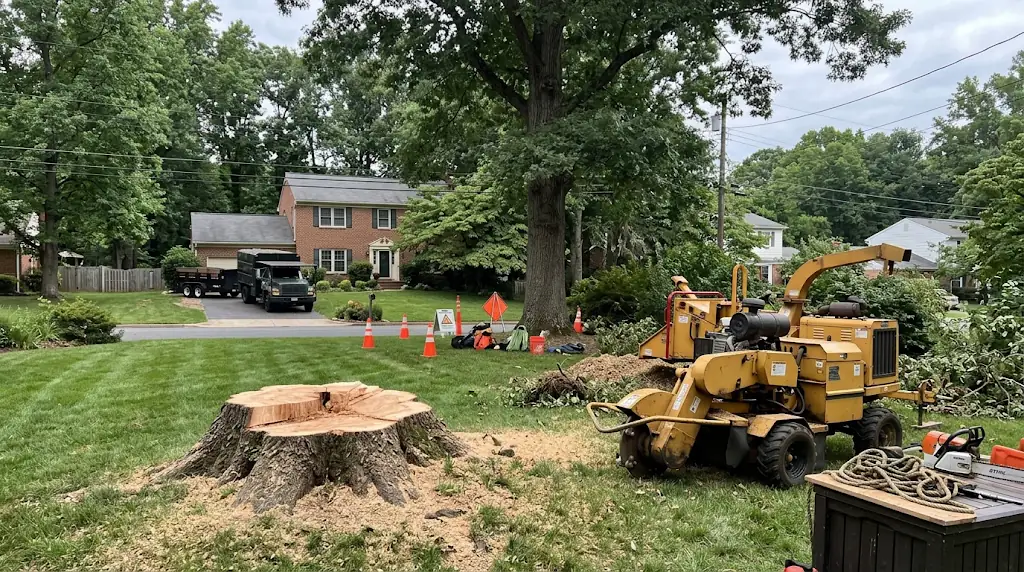
Tree removal across Northern Virginia typically costs between $450 and $2,200 for standard residential jobs, with the regional average sitting right around $1,150. Large mature hardwoods, tight zero-lot-line access in dense neighborhoods, and crane-assisted emergency removals push complex projects between $2,500 and $4,500+.
Several localized factors dictate where your invoice lands within that range. Northern Virginia (NoVA) features dense suburban architecture, mature oak and tulip poplar canopies, and distinct municipal regulations across jurisdictions like Arlington County, the City of Alexandria, and Fairfax County.
Average Tree Removal Cost by Size in Northern Virginia
Tree height and trunk diameter (DBH) are the primary baselines for removal pricing. Taller trees require rigging, sectional roping, and bucket or crane setups to lower limbs without damaging surrounding structures.
| Tree Size Category | Height Range | Typical Cost Range (NoVA) | Common Regional Species |
| Small | Under 30 feet | $250 – $600 | Dogwood, Japanese Maple, Redbud |
| Medium | 30 to 60 feet | $600 – $1,250 | Birch, Bradford Pear, Sweetgum |
| Large | 60 to 80 feet | $1,250 – $2,300 | Pin Oak, Red Maple, Eastern White Pine |
| Extra-Large / Hazardous | 80+ feet | $2,300 – $4,500+ | Willow Oak, Tulip Poplar, Sycamore |
4 Major Cost Drivers for NoVA Properties
1. Tight Yard Access and Suburban Density
In neighborhoods like North Arlington, Old Town Alexandria, and older sections of Falls Church, narrow side yards, historic fences, and detached garages prevent bucket trucks from driving directly up to the tree trunk.
- Manual Rigging & Climbing: Adds $300 to $700 in labor because arborists must dismantle the canopy branch by branch using block-and-tackle systems.
- Crane-Assisted Removal: When a massive tree cannot be safely climbed or dropped due to power lines or home rooflines, a mobile crane is brought in. Crane mobilizations add $1,200 to $2,500 to the total job.
2. Proximity to Power Lines and Infrastructure
Trees growing into primary power distribution lines require coordination with Dominion Energy. If a tree threatens a service drop or public utility easement, utility crews must de-energize or trim limbs before a private crew cuts the remainder. Complex staging around utility lines increases labor hours.
3. Tree Condition and Structural Decay
Counterintuitively, dead or decaying trees often cost more to remove than healthy ones. Severe interior rot, insect infestations (such as emerald ash borer damage in green ash trees), or root fungi make climbing dangerous. Unstable trees require specialized bucket trucks, lift platforms, or cranes, elevating equipment costs.
4. Emergency Storm Damage Removals
Northern Virginia experiences regular heavy summer thunderstorms, remnants of Atlantic tropical systems, and winter nor’easters that load pine and oak canopies with ice.
- Trees fallen onto roofs, garages, or driveways require emergency triage crews, rigging, and immediate crane access.
- Emergency storm work typically carries a 50% to 100% premium due to after-hours dispatch and elevated safety risks.
Local Regulations and Permit Costs
Before cutting down a tree, local municipal codes determine whether an inspection or permit is required:
- Arlington County: Healthy trees on private residential lots generally do not require a county permit unless the property is undergoing land development or sits within a designated Resource Protection Area (RPA) under the Arlington County Tree Canopy Regulations.
- City of Fairfax & City of Falls Church: Both jurisdictions enforce specific tree preservation ordinances. For instance, the City of Fairfax requires permits for removing trees with a diameter of 5 inches or larger at breast height on certain lots.
- Fairfax County (Unincorporated): Individual residential tree removals typically do not require permits unless situated within a Chesapeake Bay Resource Protection Area (RPA), which restricts vegetation removal within 100 feet of streams and wetlands.
- Permit Fees: Permit filings typically cost between $25 and $100 when applicable, though an arborist report (costing $150 to $350) may be required to prove disease or hazard in protected zones.
Additional Services: Grinding, Hauling, and Cleared Debris
Base tree removal estimates usually cover felling the tree and cutting branches to ground level. Additional cleanup options impact your final quote:
- Stump Grinding: $150 to $500 per stump, depending on root flare diameter and depth. Grinding below grade (6 to 12 inches) requires calling Virginia 811 (“Miss Utility”) to mark gas and water lines prior to work.
- Debris Hauling & Chipping: $100 to $350. Keeping the chips for garden mulch or having the trunk bucked into firewood rounds can reduce haul-away costs.
- Log Splitting: $75 to $150 per cord equivalent if you keep the wood on site.
Cost Breakdown by Service Area
Labor rates, transit logistics, and equipment access vary slightly across Northern Virginia:
- Arlington & Alexandria: Often land on the higher end of the pricing spectrum ($1,200 – $2,500+) due to tight lot dimensions, zero-clearance property lines, and traffic/parking permit logistics.
- McLean & Great Falls: Higher frequency of massive, 80-to-100-foot mature canopy oaks and tulip poplars that necessitate heavy crane machinery ($1,800 – $4,000+).
- Vienna, Tysons, & Falls Church: Typical suburban residential mix ($900 – $1,800) with accessible front or back yards.
- Annandale & Springfield: Consistent residential access with moderate tree heights ($800 – $1,600).
Get a Free Inspection and Upfront Quote
Safe tree removal requires experienced crews, proper rigging, and comprehensive liability insurance that protects your home and property. For an accurate, on-site assessment of hazardous or dying trees in your yard, contact Arlington Tree Removal on our contact page to schedule a free inspection and transparent estimate.